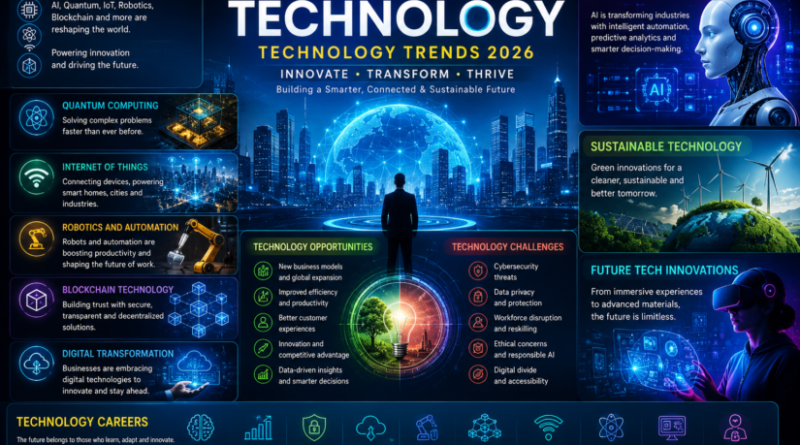
Modern Technology Trends in 2026: The Future of Artificial Intelligence, Cloud Computing, and Digital Innovation
Introduction
Modern technology in 2026 is no longer just about faster computers or better smartphones. It is about creating intelligent systems that can learn, communicate, solve problems, and make decisions with minimal human intervention. Businesses, governments, healthcare providers, educational institutions, and individuals are embracing advanced digital technologies to improve efficiency, reduce costs, increase security, and deliver better experiences.
The three major pillars driving this transformation are Artificial Intelligence (AI), Cloud Computing, and Digital Innovation. Together, these technologies are reshaping nearly every industry and creating new opportunities for economic growth and scientific advancement.
Artificial Intelligence (AI): The Brain of Modern Technology
Artificial Intelligence has become the foundation of digital transformation. Instead of simply following programmed instructions, modern AI systems can analyze information, recognize patterns, understand natural language, generate content, and continuously improve through learning.
AI is now integrated into many aspects of everyday life. Virtual assistants answer questions, recommendation systems suggest movies and products, financial institutions detect fraud in real time, and hospitals use AI to assist doctors in diagnosing diseases.
One of the most significant developments in 2026 is the rise of Generative AI, which can create text, images, videos, software code, music, and even scientific research. Businesses use Generative AI to automate customer service, generate marketing content, improve software development, and enhance productivity.
Another important trend is the emergence of AI Agents. Unlike traditional AI tools that perform a single task, AI agents can complete complex workflows independently. For example, an AI agent may research a topic, write a report, analyze data, create visual presentations, and send the final results without continuous human supervision.
Machine Learning and Deep Learning continue to improve AI performance by enabling systems to learn from large datasets. This allows businesses to make more accurate predictions, automate decision-making, and personalize customer experiences.
Cloud Computing: The Digital Infrastructure of the Future
Cloud Computing has become the backbone of the modern digital economy. Instead of maintaining expensive physical servers, organizations rent computing resources through cloud service providers. This model provides flexibility, scalability, reliability, and significant cost savings.
Cloud platforms allow businesses to deploy applications worldwide within minutes. Employees can collaborate remotely, access files securely, and run powerful software from almost any location with an internet connection.
Three primary cloud service models dominate today’s market:
Infrastructure as a Service (IaaS) provides virtual servers, storage, and networking resources.
Platform as a Service (PaaS) offers development environments where programmers can build and deploy applications without managing hardware.
Software as a Service (SaaS) delivers complete software solutions through web browsers, eliminating the need for local installations.
Hybrid Cloud and Multi-Cloud strategies have also become increasingly popular. Many organizations combine private infrastructure with multiple public cloud providers to improve resilience, reduce operational risks, and avoid dependence on a single vendor.
Cloud Computing also powers many technologies that people use every day, including video streaming platforms, online collaboration tools, e-commerce websites, financial services, gaming platforms, and artificial intelligence applications.
Digital Innovation: Transforming Every Industry
Digital Innovation refers to the use of modern technologies to improve existing products, services, and business processes while creating entirely new opportunities.
Rather than adopting technology for its own sake, organizations use digital innovation to solve real-world problems, improve customer satisfaction, increase efficiency, and remain competitive.
Several technologies contribute to digital innovation.
The Internet of Things (IoT) connects billions of devices, including smart homes, connected vehicles, industrial equipment, wearable devices, and healthcare monitoring systems. These connected devices continuously collect and exchange data, enabling smarter decision-making.
Robotics and Intelligent Automation are transforming manufacturing, logistics, agriculture, and healthcare. Modern robots can perform repetitive, dangerous, or highly precise tasks while AI systems coordinate complex operations.
Blockchain technology extends beyond cryptocurrencies by enabling secure digital identities, transparent supply chains, smart contracts, healthcare record management, and financial transactions.
Big Data and Data Analytics help organizations analyze enormous volumes of structured and unstructured information. Businesses use advanced analytics to predict consumer behavior, optimize operations, reduce costs, and identify new market opportunities.
Edge Computing processes information closer to where data is generated, reducing latency and improving performance for autonomous vehicles, industrial automation, and real-time monitoring systems.
Quantum Computing continues to advance as researchers develop computers capable of solving problems that are impossible for traditional computers. Although still emerging, quantum technology has the potential to revolutionize medicine, materials science, financial modeling, and cybersecurity.
Cybersecurity in the AI Era
As organizations become increasingly digital, cybersecurity has become more important than ever.
Cybercriminals continue developing sophisticated attacks targeting businesses, governments, healthcare providers, and individual users. To defend against these threats, organizations implement advanced cybersecurity strategies including Artificial Intelligence, Zero Trust Architecture, Multi-Factor Authentication (MFA), encryption, behavioral analytics, and continuous security monitoring.
AI-powered security systems can identify suspicious behavior within seconds, helping organizations detect attacks before they cause significant damage.
Data privacy, regulatory compliance, and secure cloud environments remain essential priorities in today’s digital landscape.
Sustainability and Green Technology
Technology companies are also focusing on sustainability.
Green Technology includes energy-efficient data centers, renewable energy, electric vehicles, intelligent power management systems, sustainable manufacturing, and environmentally friendly computing practices.
Artificial Intelligence helps optimize energy consumption by monitoring power usage, predicting equipment failures, and reducing unnecessary resource consumption.
Many organizations now include sustainability as a core component of their digital transformation strategies.
The Future of Work
Modern technology is transforming the global workforce.
Routine and repetitive tasks are increasingly automated, allowing employees to focus on creativity, strategic thinking, problem-solving, and innovation.
New careers continue to emerge, including AI Engineers, Machine Learning Engineers, Data Scientists, Cloud Architects, Cybersecurity Specialists, Robotics Engineers, Prompt Engineers, and AI Ethics Consultants.
Continuous learning has become one of the most valuable professional skills in the digital economy.
Conclusion
The technology landscape of 2026 is defined by the convergence of Artificial Intelligence, Cloud Computing, and Digital Innovation. These technologies no longer operate independently; instead, they work together to create intelligent, connected, secure, and highly efficient digital ecosystems.
Organizations that embrace innovation, invest in advanced technologies, and develop digital talent will be better positioned to compete in an increasingly technology-driven world. As AI continues to evolve, cloud infrastructure expands, and digital transformation accelerates, modern technology will continue shaping the future of business, society, and everyday life.